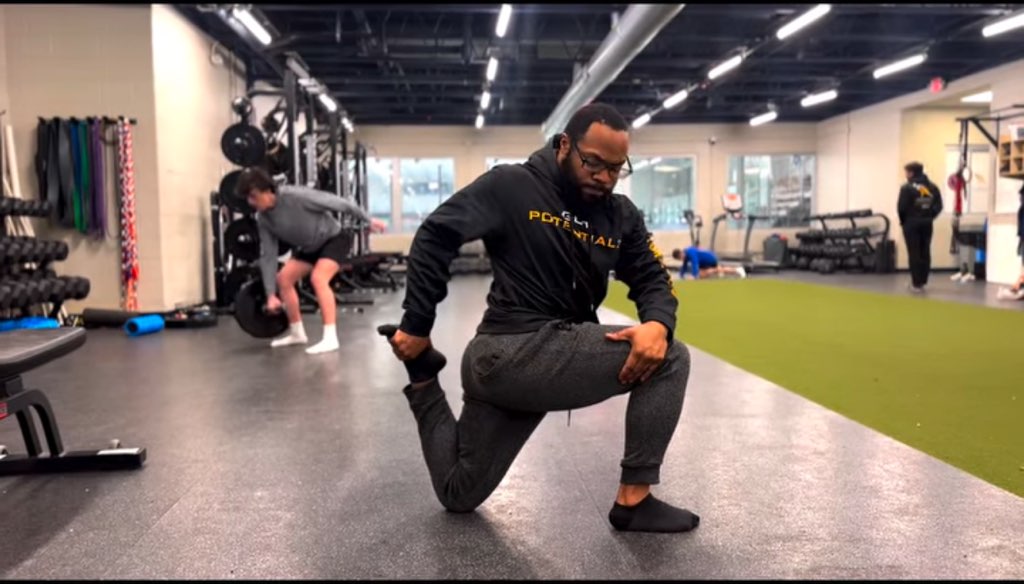
Enhanced Balance and Coordination
Yoga comes in many forms—slow, fast, hot yoga, goat yoga, and more. Regardless of the style, each type of yoga helps improve balance and coordination, making it highly beneficial for athletes.
Fast-paced yoga sequences enhance agility and reaction time, while isometric (iso) and static holds strengthen stability. This is essential for athletes in various sports:
- Basketball players need balance to tightrope the baseline and save a ball in play.
- Football players rely on stability to make precise sideline catches while staying in bounds.
- Hockey players benefit from enhanced hip mobility and control to avoid hits while maintaining scoring precision.
By training the body to move with control and efficiency, yoga helps athletes react faster and perform with greater stability under pressure.
Mental Strength and Body Awareness
Yoga also sharpens mental focus and body awareness, key elements for athletic performance. Through the practice of Drishti (a focused gaze technique), athletes can improve concentration, spatial awareness, and balance control—all crucial for precise movements in sports.
Additionally, yoga enhances proprioception (the body’s ability to sense movement and position) by strengthening the mind-body connection. Controlled breathing and breathwork play a vital role in reducing stress, improving focus, and regulating emotions, all of which contribute to peak athletic performance.
Incorporating yoga into training can give athletes a competitive edge by optimizing both physical and mental performance.
Tying It Altogether
Many athletes think of yoga as just stretching, but it offers far more—enhancing strength, mobility, balance, endurance, and mental focus. By incorporating yoga into their training, athletes can improve core stability, strengthen deep muscle groups, and enhance movement efficiency, reducing the risk of injury. Additionally, breathing techniques like diaphragmatic and nostril breathing help optimize oxygen intake, improve endurance, and reduce stress. Yoga also sharpens balance, coordination, and body awareness, benefiting athletes in sports requiring agility and control. With its physical and mental benefits, yoga is a powerful tool for enhancing athletic performance and recovery.
Written By:
Darrid Watson, CSCS, NSCA-CPT
Take action… Now!
Voorhees Flyers Training center.
The Hollydell ice arena, in the main building.